

Two Booked After Dog’s Hind Legs Broken in Assault in Aligarh Following Intervention by Jeev Daya Foundation and PETA India
After receiving information and a video showing a female dog suffering from fractures to both hind legs following a dastardly attack allegedly at the hands of two villagers, PETA India worked with Aasha Sisodia, founder of Jeev Daya Foundation Aligarh, the dog’s local caregiver, and officials at Gabhana Police Station to help ensure that a First Information Report (FIR) was registered under relevant provisions of the law.
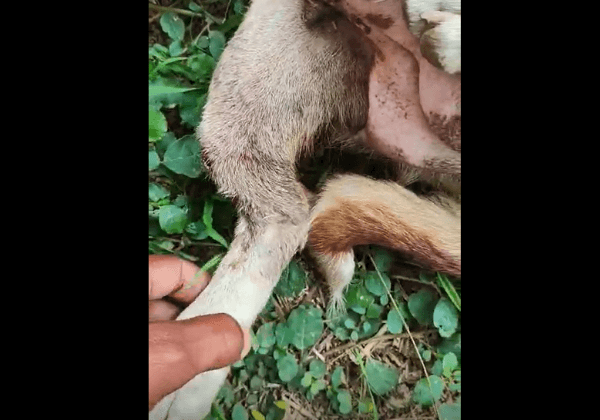
The incident occurred on 13 May in Piphloth village, Aligarh. According to reports, two residents of the village allegedly attacked the female community dog, causing the fractures. The accused reportedly informed other villagers about the assault, prompting the dog’s caregiver to search for her. The dog was eventually found lying injured near DDPS School and was immediately rushed to a private veterinary facility for treatment, where she underwent surgery. Working in coordination with PETA India, Mrs. Sisodia submitted a complaint to the Gabhana Police Station, following which an FIR was registered against Bablu Jatav and Pappu Jatav for allegedly maiming the dog. A government veterinarian subsequently conducted a medical examination of the animal. The dog is currently recovering and receiving postoperative care.
An FIR was recently registered under Section 325 of the Bharatiya Nyaya Sanhita (BNS), 2023, and Section 11 of the Prevention of Cruelty to Animals (PCA) Act, 1960. Section 325 of the BNS, 2023, categorises mischief by killing, poisoning, maiming, or rendering useless of any animal as a cognisable offence and prescribes a punishment of imprisonment for a term which may extend to five years, or with a fine, or with both.
PETA India recommends that perpetrators of animal abuse undergo psychiatric evaluation and receive counselling, as abusing animals indicates a deep psychological disturbance. Research shows that people who commit acts of cruelty to animals are often repeat offenders who move on to hurting other animals, including humans. A study published in Forensic Research & Criminology International Journal stated, “Those who engage in cruelty to animals were [three] times more likely to commit other crimes, including murder, rape, robbery, assault, harassment, threats, and drug/substance abuse.”
PETA India has long campaigned to strengthen the PCA Act, 1960, which contains outdated, inadequate penalties, such as a maximum fine of only Rs 50 for convicted first-time offenders (although the BNS, 2023, prescribes stronger punishments). In a proposal sent to the central government regarding an amendment to the PCA Act, PETA India has recommended significantly increasing penalties for cruelty to animals.